How to Calculate Safe Working Load (SWL)
In the lifting industry, acronyms like SWL, WLL, and MBL are thrown around constantly. But confusing them can lead to dangerous overloading. This guide breaks down exactly what Safe Working Load (SWL) means, how it differs from Working Load Limit (WLL), and how to calculate it.
Definitions: WLL vs. SWL vs. MBL
Before calculating, we must define the terms:
- MBL (Minimum Breaking Load): The load at which the lifting equipment will fail or break. This is determined by destructive testing.
- WLL (Working Load Limit): The maximum mass that the lifting gear is designed to raise, lower, or suspend. This is set by the manufacturer.
- SWL (Safe Working Load): The maximum load that the equipment can safely lift in a specific application. This is often the same as WLL but can be lower depending on the angle of use or environmental conditions.
The Safety Factor (SF)
The Safety Factor is the ratio between the Minimum Breaking Load (MBL) and the Working Load Limit (WLL). It provides a margin of error for wear, shock loading, and imperfections.
Common Safety Factors:
- Wire Ropes: Typically 5:1
- Chain Slings: Typically 4:1
- Synthetic Slings: Typically 7:1
- Shackles: Typically 6:1
Calculating SWL
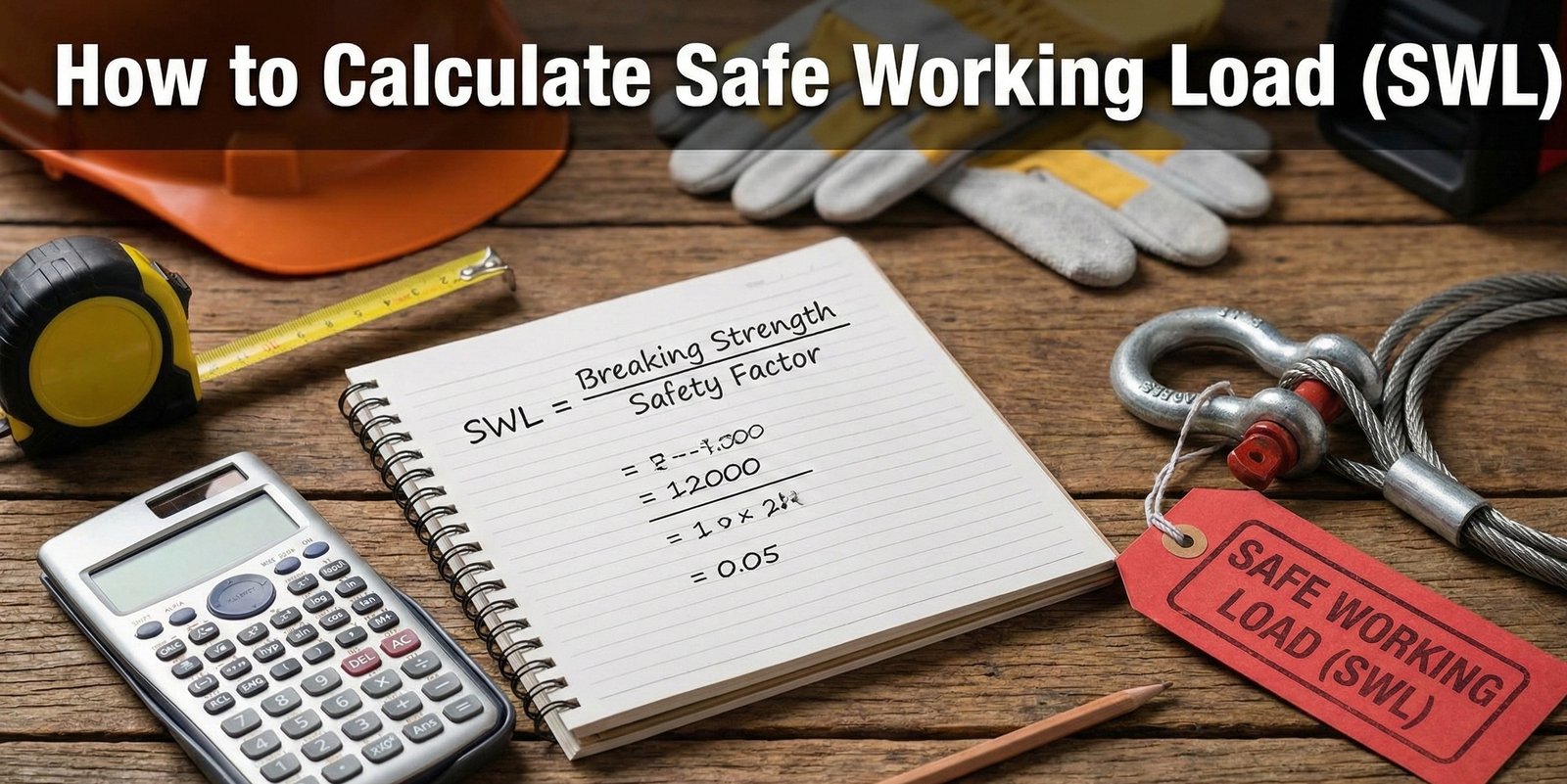
To calculate the Safe Working Load, you start with the Minimum Breaking Load (MBL) and divide it by the Safety Factor (SF).
Example: You have a wire rope with a Minimum Breaking Load of 10 tonnes. The standard safety factor for wire rope is 5:1.
SWL = 10 tonnes / 5 = 2 tonnes.
So, even though the rope breaks at 10 tonnes, you should never lift more than 2 tonnes with it.
Derating for Angles (Sling Angles)
When using slings at an angle, the tension in each sling leg increases. You must "derate" the SWL.
The formula for the load on each leg is:
Alternatively, use the Mode Factor:
- 0° - 45°: Factor = 1.4 (for 2 legs)
- 45° - 60°: Factor = 1.0 (for 2 legs)
Critical Rule: Never use a sling at an angle less than 30° from the horizontal (or greater than 120° included angle) as the tension becomes exponentially high.
Proof Load Test
A Proof Load Test is a mandatory test performed to validate the SWL. Typically, the crane or hoist is loaded to:
- 125% of SWL (for many international standards)
- 110% of SWL (for some specific dynamic tests)
This ensures the equipment can handle the rated load with a safety margin without permanent deformation.