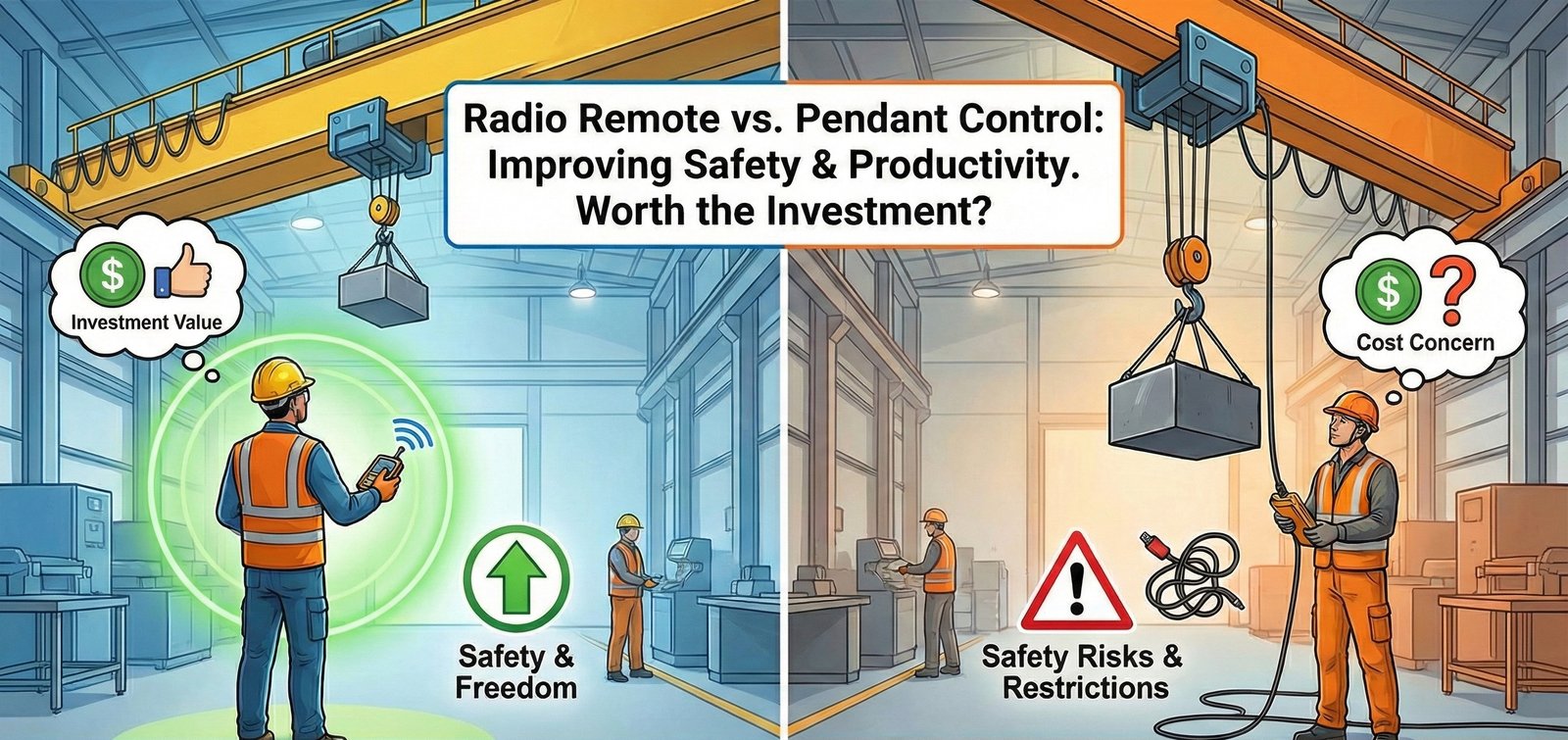
Radio Remote vs. Pendant Control: Which is Safer?
The debate between wired pendant stations and wireless radio remotes has been ongoing for years. While pendants are reliable and cheap, radio remotes offer freedom of movement. But which one actually improves safety and productivity?
1. Pendant Control (Wired)
The traditional method. A control box hangs from the crane hoist via a cable.
Pros:
- Reliability: No batteries to charge. No signal interference. It just works.
- Cost: Very inexpensive to install and replace.
- Hard to Lose: It's physically attached to the crane!
Cons:
- Safety Hazard: The operator must walk close to the load (often right next to it). This puts them in the "danger zone" if the load swings or drops.
- Trip Hazard: The operator has to navigate obstacles on the floor while dragging the pendant cable.
- Speed: The operator can only move as fast as they can walk through the cluttered shop floor.
2. Radio Remote Control (Wireless)
A handheld transmitter sends signals to a receiver on the crane bridge.
Pros:
- Safety: The operator can stand far away from the load, getting a better view and staying out of the crush zone.
- Productivity: The operator can take the safest and fastest path through the factory floor without being tethered to the crane.
- Versatility: Can control multiple cranes (tandem operation) easily.
Cons:
- Battery Management: Requires disciplined charging routines.
- Interference: Rare in modern systems, but possible in high-RF environments.
- Cost: Higher upfront cost.
The Safety Verdict
Radio Remotes are safer. The ability to stand back and view the lift from the best possible angle—without tripping over cables or being under the load—is a massive safety advantage.
Recommendation: Keep the pendant as a backup (plug-and-play) in case the remote breaks or batteries die, but use the radio remote for daily operations.