VFD vs. Contactor Control for Hoists: Which is Better?
For decades, contactor-based controls were the standard for EOT cranes. They were simple, rugged, and understood by every electrician. However, with the advancement of power electronics, Variable Frequency Drives (VFDs) have become the new gold standard. But is a VFD always the right choice? Let's compare the two technologies.
1. Contactor Control (Direct-on-Line / Soft Starters)
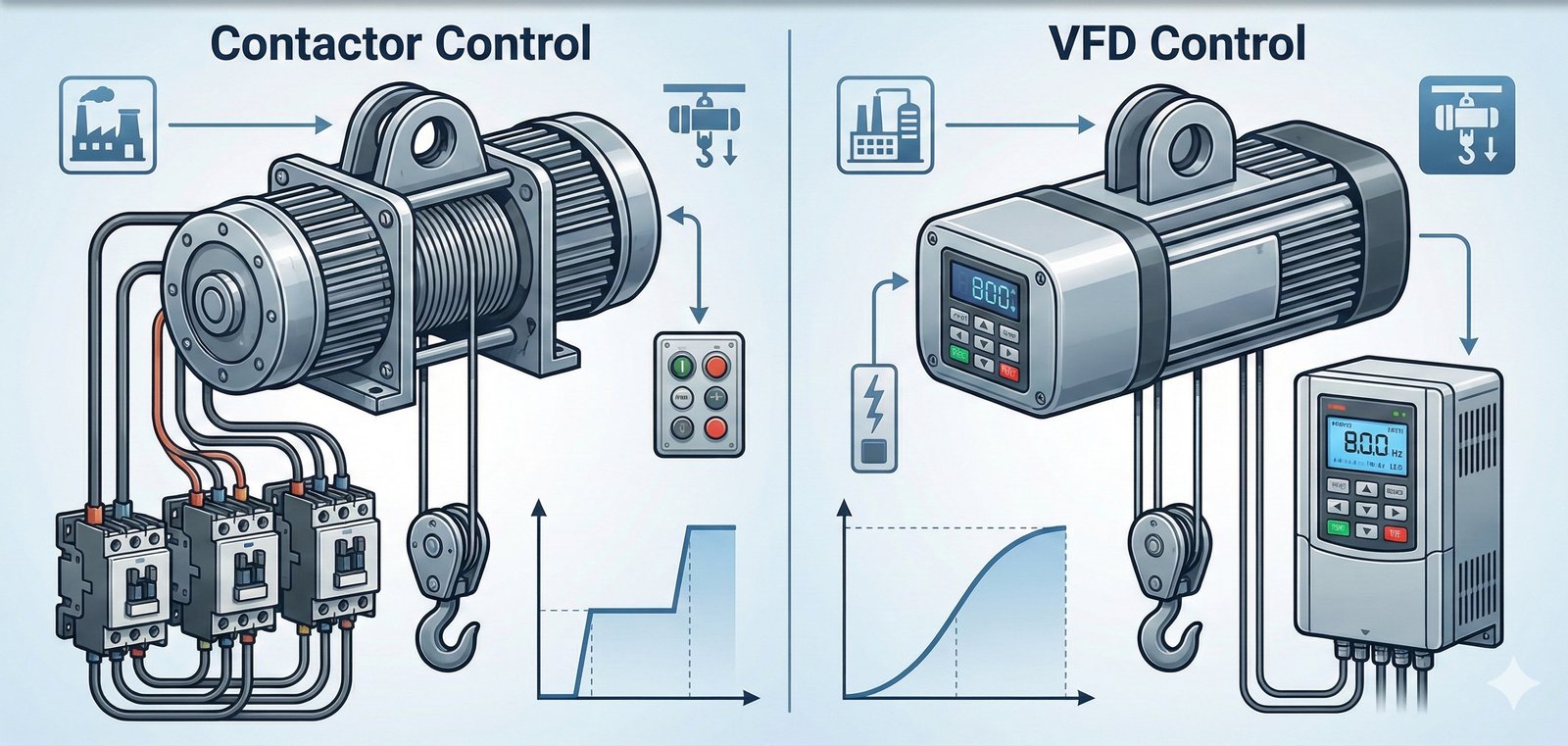
Contactor controls work by switching the motor directly to the power supply. Speed control is usually limited to single-speed or dual-speed (using pole-changing motors).
Pros:
- Lower Initial Cost: The components are cheaper than VFDs.
- Simplicity: Easy to troubleshoot with a multimeter. No programming required.
- Robustness: Less sensitive to heat and dust compared to sensitive electronics.
Cons:
- Jerky Movements: Starting and stopping are abrupt, causing load sway.
- High Mechanical Wear: The shock loads damage gears, couplings, and brakes.
- High Inrush Current: Motors draw 6-7 times their rated current during startup.
2. Variable Frequency Drive (VFD) Control
A VFD controls the motor speed by varying the frequency and voltage supplied to the motor. This allows for infinite speed adjustment from zero to full speed.
Pros:
- Smooth Operation: "Stepless" speed control eliminates jerky starts and stops, significantly reducing load sway.
- Reduced Mechanical Wear: Soft starts and stops mean less stress on gears and brakes. Brakes are used only for holding, not for stopping the load.
- Precision Positioning: Operators can move loads at very slow speeds (creep speed) for precise placement.
- Energy Efficiency: Reduces peak power demand.
Cons:
- Higher Initial Cost: More expensive to buy and install.
- Complexity: Requires specialized knowledge to program and troubleshoot.
- Environment Sensitive: Needs a clean, cooled panel environment.
Comparison Table
| Feature | Contactor Control | VFD Control |
|---|---|---|
| Speed Control | Fixed (1 or 2 steps) | Variable (Stepless) |
| Load Sway | High | Minimal |
| Brake Wear | High (Brake stops load) | Low (Brake holds load) |
| Cost | Low | High |
Recommendation: For maintenance cranes used infrequently, contactor control is sufficient. For production cranes or applications requiring precision (e.g., die handling, assembly), VFD is the superior choice.