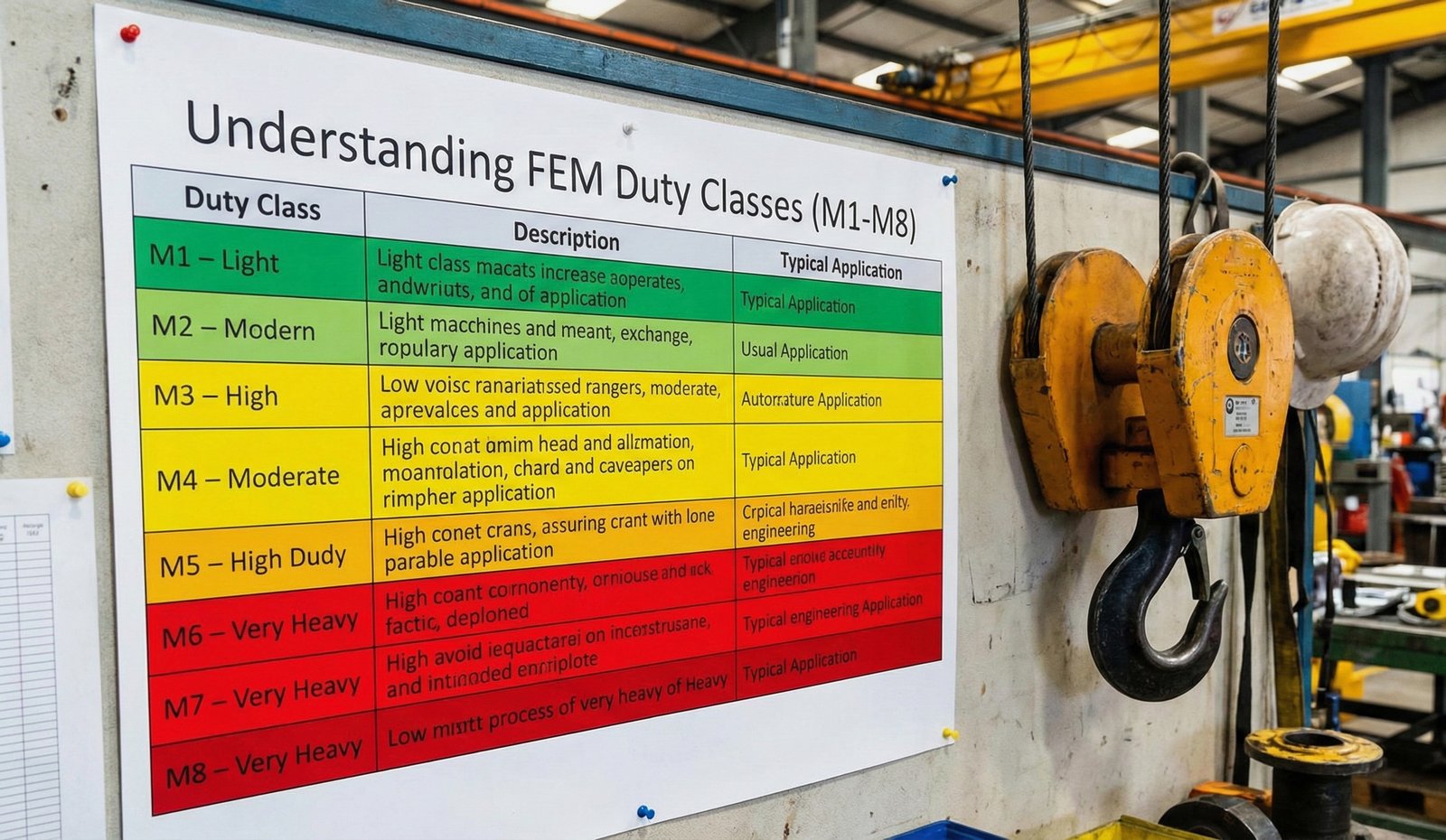
When you buy a car, you don't use a sedan to haul gravel every day. Similarly, you can't use a maintenance crane for 24/7 production. This is where Duty Classes come in.
The FEM (Fédération Européenne de la Manutention) and ISO standards classify cranes based on how hard they work. This classification, ranging from M1 to M8, determines the design life of the gearbox, the diameter of the wire rope, and the robustness of the motor.
What Determines the Duty Class?
The duty class is calculated based on two main factors:
- Load Spectrum (k): How often do you lift the maximum capacity? (Do you always lift 100% load, or mostly 30% load?)
- Average Daily Operating Time (t): How many hours per day is the hook actually moving?
The Classes Explained
Light Duty (M1 - M3)
These cranes are designed for maintenance or standby use. They sit idle most of the time.
- Typical Use: Powerhouse maintenance, pump stations, workshops.
- Lifespan: Designed for occasional use. If used for production, they will fail within months.
Medium Duty (M4 - M5)
The industry standard for general manufacturing and warehousing. This is what most factories need.
- Typical Use: Machine shops, assembly lines, general warehousing.
- Characteristics: Can handle a mix of light and heavy loads throughout a single shift.
Heavy Duty (M6 - M7)
These are production workhorses. They run constantly, often lifting near-maximum loads.
- Typical Use: Steel stockyards, foundries, magnet cranes, grab buckets.
- Characteristics: Oversized motors, heavier gearboxes, and thicker wire ropes to withstand heat and wear.
Severe Duty (M8)
The highest classification. These cranes operate 24/7/365 at full capacity.
- Typical Use: Waste-to-energy plants, automated process cranes, hot metal ladles.
Comparison Table: ISO vs FEM vs CMAA
| ISO | FEM | CMAA (USA) | Description |
|---|---|---|---|
| M1 - M3 | 1Bm | Class A / B | Light / Infrequent |
| M4 | 1Am | Class C | Moderate Service |
| M5 | 2m | Class D | Heavy Service |
| M6 | 3m | Class E | Severe Service |
| M7 - M8 | 4m / 5m | Class F | Continuous Severe |
Why Does It Matter?
Warning: Using an M3 crane in an M6 application is dangerous.
The gearbox gears will pit, the motor will burn out from overheating, and the wire rope will fatigue rapidly, leading to potential load drops.
Conversely, buying an M7 crane for a simple maintenance job is a waste of money. You are paying for heavy steel and massive motors that you will never fully utilize.
Summary
Before asking for a price quote, define your duty cycle. Be honest about how often you will use the crane. It is the single most important factor in ensuring your equipment lasts for 20 years instead of 2.
Not Sure What You Need?
Our directory lists engineering consultants and manufacturers who can help analyze your workflow and recommend the perfect duty class.
Consult an Expert