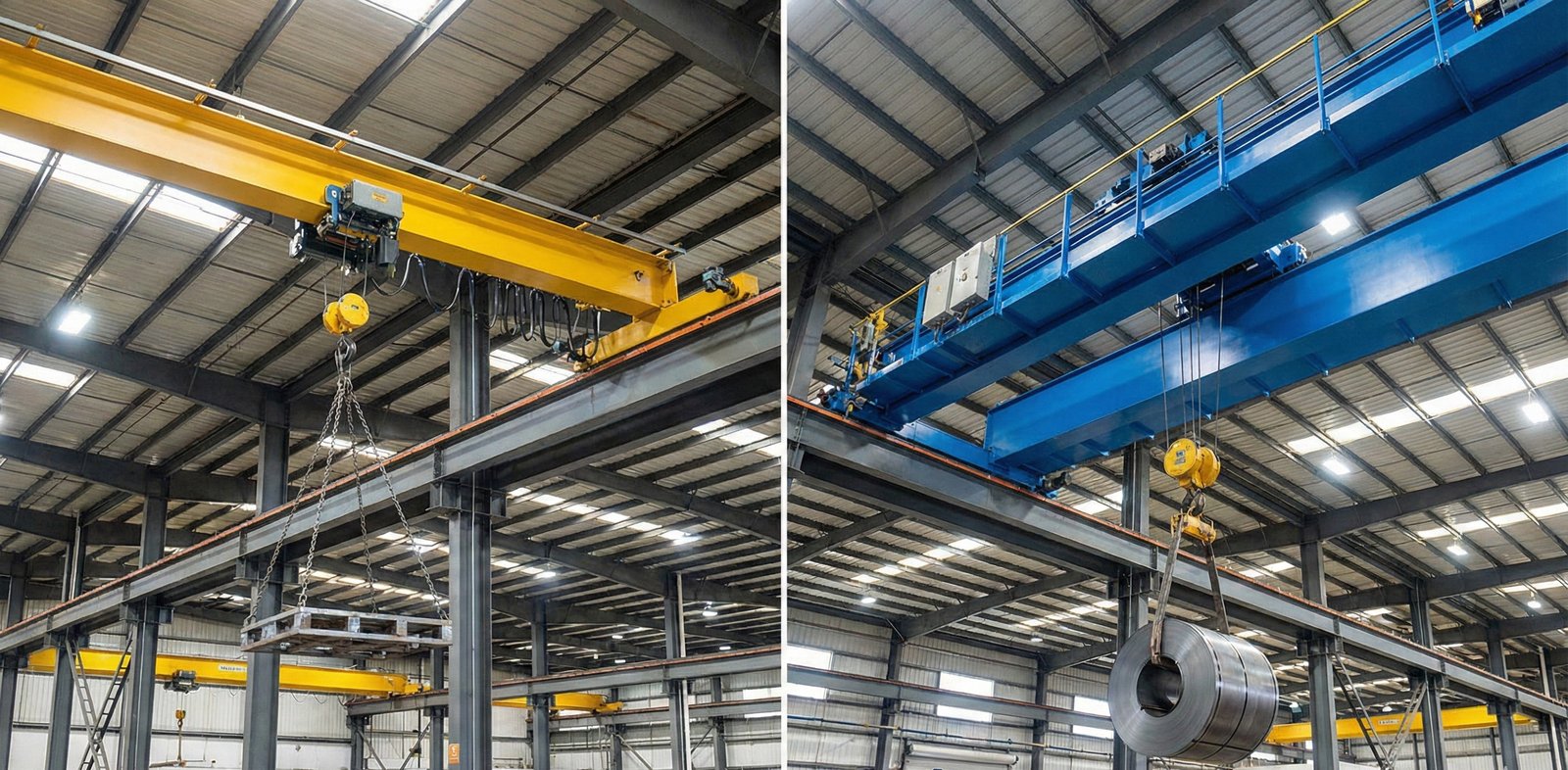
One of the first decisions you'll face when purchasing an EOT crane is whether to go with a Single Girder or Double Girder design. This choice isn't just about price; it fundamentally affects how the crane fits into your building and how much load it can handle.
While both types serve the same purpose—lifting and moving heavy loads—their structural differences make them suitable for different applications. Let's break down the key factors.
1. Single Girder Cranes
As the name suggests, a Single Girder crane has one main bridge beam. The hoist trolley hangs underneath this beam (underslung) or runs on the bottom flange.
Pros:
- Cost-Effective: Uses less steel and lighter components, making it 20-30% cheaper than a double girder equivalent.
- Lighter Dead Weight: Puts less stress on your building's runway beams and columns, potentially saving on building construction costs.
- Easier Installation: Fewer components and lighter weight make installation faster and simpler.
Cons:
- Lower Lifting Height: Since the hoist hangs below the beam, you lose some vertical hook height compared to a double girder where the hoist sits on top.
- Capacity Limits: Generally limited to loads under 20 tons and spans under 30 meters.
- Maintenance Access: Often requires a scissor lift or mobile platform for maintenance, as there is usually no walkway on the girder.
2. Double Girder Cranes
Double Girder cranes have two bridge beams. The hoist trolley (often called a "crab") travels on top of rails mounted to these girders.
Pros:
- Maximum Lifting Height: The hook can be pulled up between the two girders, giving you significantly more vertical lift (1-2 meters more) for the same building height.
- Higher Capacity & Span: Essential for heavy loads (over 20 tons) and wide spans (over 30 meters) where a single beam would sag too much.
- Maintenance Walkway: Usually includes a full-length walkway, allowing safe and easy access to motors, brakes, and electrical panels without needing a lift.
- Durability: Better suited for heavy-duty cycles (Class M6/M7/M8) and harsh environments.
Cons:
- Higher Cost: More steel, more complex trolley, and higher shipping costs make it more expensive.
- Heavier Dead Weight: Requires stronger (and more expensive) runway beams and building columns.
Comparison Table
| Feature | Single Girder | Double Girder |
|---|---|---|
| Cost | Lower ($) | Higher ($$) |
| Max Capacity (Typical) | Up to 20 Tons | Up to 500+ Tons |
| Hook Height | Standard | Maximized |
| Maintenance | Requires Lift | Walkway Access |
Which One Should You Choose?
Choose Single Girder If:
- Your load is under 15-20 tons.
- Your span is under 25-30 meters.
- You are on a tight budget.
- You have plenty of building height and don't need to squeeze every inch of lift.
Choose Double Girder If:
- You need to lift more than 20 tons.
- You have a very wide span.
- Headroom is critical: You need to lift high but have a low ceiling.
- The crane will be used constantly (heavy duty cycle).
- You want easier maintenance access for your team.
Engineering Tip: Always check your building's column strength before choosing Double Girder. The extra weight might require expensive structural reinforcements.
Summary
There is no "better" crane, only the right crane for your specific application. Single girders are the economical workhorses for light-to-medium duty, while double girders are the heavy-lifters designed for maximum height and capacity.
Still unsure? Use our Girder Calculator to see preliminary sizing for your span and load.
Ready to Buy?
Connect with verified manufacturers who can build both Single and Double Girder cranes to your specs.
Find Manufacturers