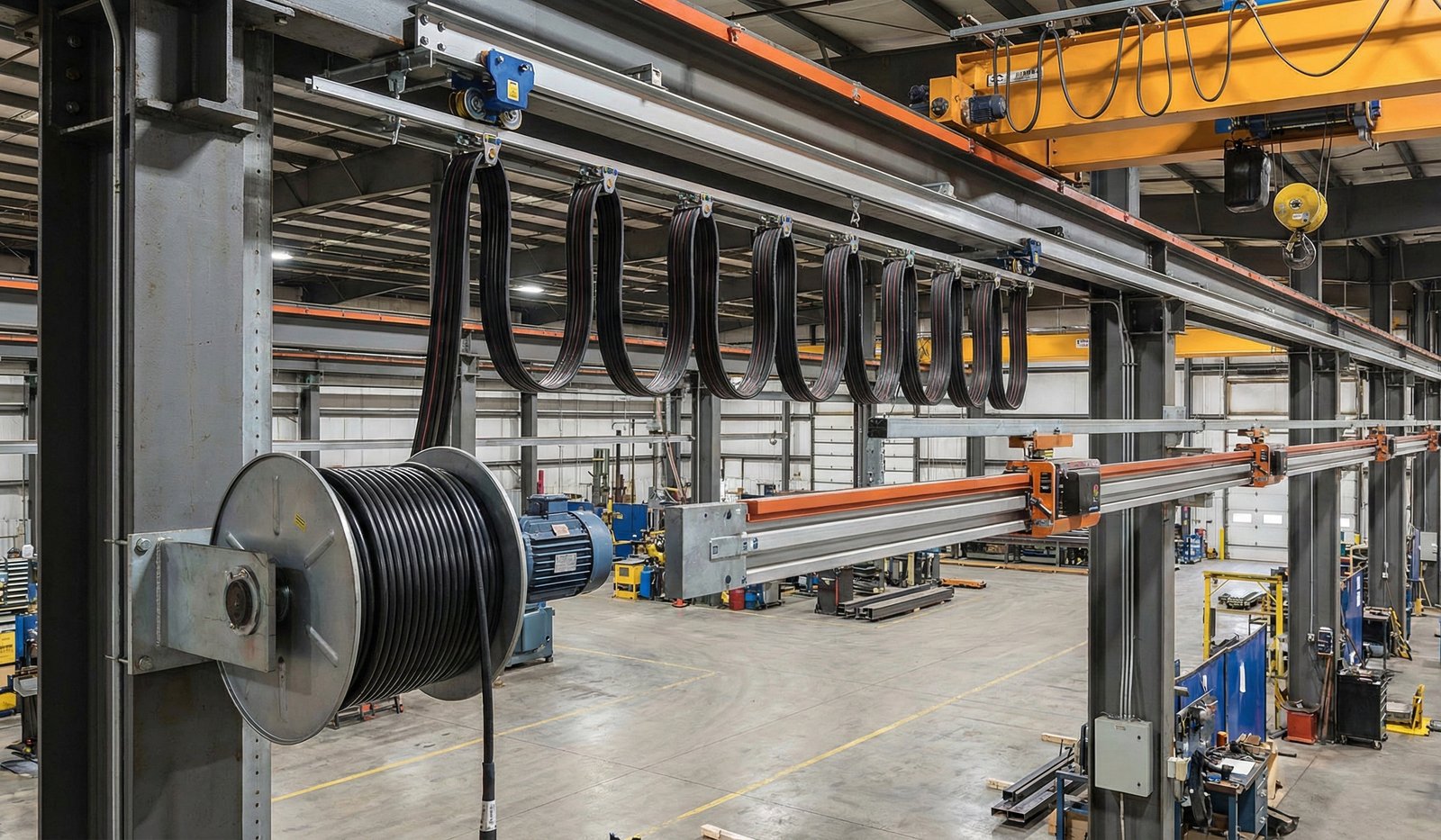
Multiple Cranes on the Same DSL / Busbar Bay
Quick Answer
If two or more cranes share one DSL/busbar, ask vendors to show each crane current, simultaneity assumption, worst-case operating position, feed arrangement, busbar rating, collector rating, and spare capacity for future expansion.
The common mistake is designing the DSL as if only one crane exists. In real production bays, two cranes may travel, hoist, or start near the same time, and the farthest crane can see the weakest voltage.
Different CurrentsDo not assume every crane has the same current.
SimultaneityDefine how many cranes can run together and at what load.
Feed StrategyLong shared bays often need center or multiple feed points.
Checklist for Shared DSL Bays
| Check | Question | Why It Matters |
|---|---|---|
| Crane list | What is the current of each crane? | Different cranes may have very different current draw. |
| Operating case | Which cranes can operate together? | Defines design current and voltage drop. |
| Physical location | Where are cranes when worst-case current flows? | Far-end current path affects voltage drop. |
| Feed points | How many feeds and where are they located? | Reduces path length and voltage drop. |
| Expansion | Will another crane be added later? | Future crane additions can overload a barely-rated DSL. |
Vendor Questions
- Please provide current for each crane sharing the DSL.
- Please state the simultaneity factor and worst-case operating scenario.
- Please confirm whether center feed, dual feed, or multiple feed points are needed.
- Please confirm busbar rating after applying design margin.
- Please confirm collector rating and quantity per crane.
Calculate Shared DSL Voltage Drop
Use the calculator’s individual crane current field for different crane currents in the same bay.
Open Calculator